Payment service provider

Everything you need to know about a PSP.

A payment service provider (PSP) handles payments between businesses and their customers, bringing together all the intermediary parties in the chain into a broader financial system: consumers, merchants, payment platforms, payment methods, card networks and banks. This ensures a fast, seamless and secure payment experience.

PAY. Atmosphere Photography7960
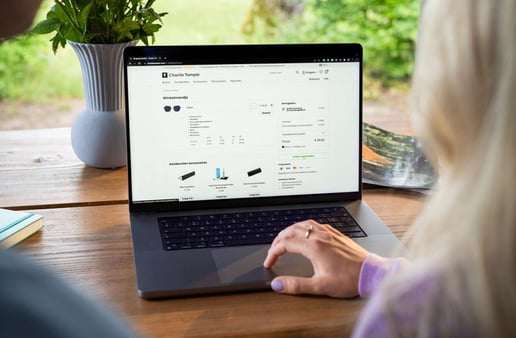
Payments from consumer to webshop.

Payment service providers facilitate payment transactionsonline,in-store and omnichannel. At the front end, i.e. what the customer sees, of a webshop (or at the checkout), a payment service provider arranges for customers to choose thepayment methods of their preference, and they deal with entering the payment details. On the back end, a PSP works with merchants, payment platforms, payment methods, card networks and banks to ensure that the purchase amount actually goes from A to B - that is, from a customer to a merchant's bank account.

Why do you need a payment service provider?

Without a PSP, you have to set up each individual payment method in your webshop independently. This also means that you have to arrange a separate agreement and implementation for each payment method. A lot of work, and a lot of hassle. In terms of costs, it makes much more sense to use one party that understands arranging online payments and the technical implementation in your website: the payment service provider.

How does a payment service provider process payments?

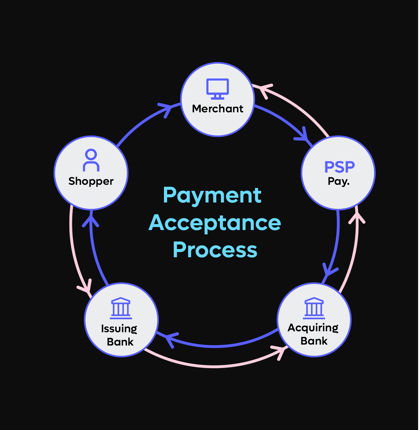
Payment processing varies by payment method - for example, processing a credit card transaction viaVisa or Mastercard is very different from processing a payment viaiDEAL or Klarna, for example. In any case, the transaction begins when the paying customer's payment details are retrieved and sent to the payment service provider. For credit card transactions, the most common payment method in e-commerce, we distinguish the following steps below:

Payment-Acceptance-Process-1

1. Verification

The Issuing Bank, that is, the buyer's bank, verifies that the payment details are valid and that there are sufficient funds in the bank account or card to process the payment, including through the CVV or CVC, for example.

2. Authorization

If everything checks out, the payment service provider authorizes the payment. This is one of the most important steps in the transaction. If the transaction is approved, the amount is caught or reserved for the merchant in the customer's payment funds. This process takes only a few seconds.

3. Settlement

Once the transaction is authorized, fees are charged to process the payment, and it is processed. The selling party's bank then receives the funds, and deposits them into the merchant's bank account.
The benefits of a payment service provider.

With a payment service provider, merchants accept payments made through various local and international payment methods through a single gateway - the cost savings and efficiency involved is the biggest benefit of a payment service provider. In addition to this, there are other benefits of using a payment service provider:

  • Online payment transactions are fast, secure and efficient
  • Payment service providers are cost-effective
  • Simplicity: you can access a wide range of payment methods with one basic contract
  • Shorter administration time for businesses
  • Secure systems
  • Fraud detection
  • Ability to accept global payments in different currencies
PAY. Atmosphere Photography8082-1
Licenses and permits.

Any party providing payment services must comply with national and sometimes international regulations. To ensure secure processing of sensitive payment and consumer data, for example, certificates such as PCI-DSS, GDPR and ISAE 3402 have been created.

Cost of a payment service provider.

The fees charged by PSPs vary. They are sometimes based on single transactions, but more often on volume packages and percentages of the purchase amount. Which package is best suited will always be discussed during startup.

Pay.-has-a-new-logo,-new-house-style-and-a-new-website-1-1-1

Differences among payment service providers.

Mutual differences in services between payment service providers lie mainly in the choice of payment methods offered. Moreover, not all providers support payments from cell phones, which is important for web shops nowadays. Others cooperate with foreign banks so that foreign visitors can also pay. In addition, PSPs often offer modules on risk and fraud at different levels. Finally, there are PSPs that offer post-payment, which is interesting if you have a lot of volume.

Advantages of Pay. as a payment service provider.
  • Largest selection national and international payment methods
  • Best rates in the market
  • Volume discount
  • Comprehensive fraud prevention through Verify by Pay.
  • Link with accounting software
  • 24/7 technical support
  • Licensed by the Dutch Central Bank
  • Online, in-store and omnichannel payments through one provider
  • Insight into all transactions and business insights

Do you have a webshop? Or about to set one up? Then arrange your payments through Pay, the fastest growing payments service provider in the Benelux. Contact us now at sales@pay.nl.

Register now and discover the benefits of Pay

Instantly arrange all your online and in-store payments.

  • Payments within 15 minutes
  • All information on one platform
  • Maximum insight into your payment traffic